Friday, August 7, 2015

IEA Raises Issues With 40year Development Plan


THE INSTITUTE OF ECONOMIC AFFAIRS (IEA-GHANA)
PRESS STATEMENT ON LAUNCH OF PREPARATORY WORK FOR A FORTY-YEAR (2018-2057) NATIONAL DEVELOPMENT PLAN FOR GHANA
Introduction
The IEA commends the National Development Planning Commission (NDPC) for steps towards developing a 40-year (2018-2057) National Development Plan (NDP) for Ghana. While we consider this a worthy cause, we wish to draw attention to some fundamental issues that need to be addressed in order to derive meaningful gains from this process. 

·         The IEA has undertaken extensive research on the issue of national development planning and considers it a critical national issue. It was one of seven key recommendations contained in an IEA report titled: The Winner-Takes-All Practice of Governance in Ghana – Proposals for Reform, submitted to the President’s Advisor on Governance, Mr. Daniel Batidam, on 15th January, 2015, for the attention of His Excellency President Mahama. The 29-page report states on page 14 as follows (on national development planning):

·         “… The Committee (IEA-WTA Committee) in principle, shares the view that there should be a long-term national perspective plan formulated through broad consensus with inputs from all across the political divide which must reflect the views of identifiable groups both at the local and national level. The plan should guide all governments irrespective of which political party is in power. The manifestoes of political parties should explain how their policies and programmes would help achieve targets in the plan. Among other things, through the appointment process and conditions of service, personnel of the NDPC should be totally insulated from politics and political control. This provision must be entrenched in the Constitution. These interventions will ensure that all political parties voted to power are guided by the plan and are assessed by the extent to which they have implemented the national development agenda.”
Key Issues
·         Our years of research point to the fact that development plans have not yielded the required benefits to us as a nation because successive governments have all too often abandoned plans by previous governments.

·         In other cases, governments have simply changed policy focus and relegated national plans to the background. It has become the norm for governments to focus on implementing their party manifestoes instead of the national development plan.


·         These are the issues that have stifled meaningful gains from previous initiatives such as the Development Plan for National Reconstruction and Development (1963), Vision 2020 (1997), Ghana Poverty Reduction Strategy (GPRS I&II), among others.  
Proposals
It is against this background that The IEA has made the following key proposals in its publications and at numerous advocacy workshops:
·         That the NDPC should be made an independent and autonomous body charged with the responsibility of formulating and overseeing the implementation of a long term national development plans for Ghana. The current partisan mode of appointment of the head of the NDPC undermines the Commission’s independence.

·         That the National Development Plan should be entrenched in Ghana’s Constitution in order to make it truly binding on successive governments. Successive governments have consistently flouted legislations that are not entrenched. It is logical to expect that a national development plan that is not anchored in the constitution will be abandoned with a change in government. An entrenched plan would bind successive regimes and halt the tragedy of policy discontinuity that continues to undermine our development.

·    Ensure that the process of preparing the national development plan is open, transparent and inclusive of all stakeholders in order to ensure public buy-in and ownership of the final policy blueprint.

Conclusion
The on-going constitution review process provides the country with an opportunity to make critical amendments which lie at the heart of Ghana’s development challenges. We urge the government to take advantage of this golden opportunity to amend the clauses of the Constitution in order to give autonomy to the NDPC and also, entrench the National Development Plan to make it truly binding on all successive governments.
Signed
Mrs. Jean Mensa
Executive Director, IEA

Dated: 6th August, 2015
Contact:
Dr. Ransford Gyampo
Research Fellow (IEA) Tel: 0244277275


Ghana, Morocco Renew Ties

July 30, 2015

By Edmund Mingle

MadamM’Hammdi, delivering her address while Mrs. Dzifa Attivor,
 Transport Minister, looks on.

Ghana and Morocco have renewed their bilateral ties in which the two have recommitted themselves to intensified economic cooperation.

The relationship between the two countries was rejuvenated this year with the opening of the first Joint-Commission for Cooperation in Rabat, resulting in opening up partnerships between Ghanaians and 
Moroccans.

At a reception in Accra on Thursday to commemorate the Kingdom of Morocco’s National Day celebrated with The Feast of the Throne,  Madam Nezha Alaoui M’Hammdi, Moroccan Ambassador to Ghana and Mrs. Dzifa Attivor, Minister of Transport, conveyed their respective governments’ commitment to their friendship.

According to the Ambassador, recent developments including the signing of various bilateral agreements and the increase in investment by Moroccans in Ghana, pointed the high confidence the two countries had in each other.

Proposing the toast, she said the first joint commission meeting has set the pace for cooperation in areas of common interest such as tourism, trade, marine fisheries, transport and energy sectors.

In that regard, she announced that a Moroccan business delegation was expected to visit Ghana soon to explore investment and partnership opportunities with the Ghanaian private sector.

“I express the wish that the new progressive dynamics now engaged between our two countries, marks the renewal, the rebirth of the age-old ties of friendship and solidarity dating back to Casablanca conference in 1961, for the beneficial partnership for both Moroccan and Ghanaian populations,” she said.

She was optimistic that the growing friendship will continue to create the platform for sharing of ideas towards addressing common developmental challenges, adding that Morocco admires Ghana’s democratic values.

“Ghana continues to exhibit strong leadership in democratic governance in Africa, and it is a confirmation of the degree of maturity and entrenchment of Ghana’s democratic culture,” she observed.

On the continental scale, she noted that Morocco attached priority to development, peace, stability and security in Africa, adding that its action is inspired by the secular civilisation that aims at promoting shared peace and prosperity.

She said Morocco believes in the need for collective effort to combat security threats posed by extremism, saying because such threats affect all countries, there was the need “for an inter-regional collective and inclusive response from North, East, Central and West Africa.”

Mrs. Attivor, responding to the toast, said Ghana was impressed with the unparalleled economic and democratic development in Morocco.

“The fact that Morocco was spared the Arab-spring that engulfed parts of North Africa, is a testament of the confidence the people have in the leadership of the King of Morocco, and his government’s democratic and development interventions,” she said.

She also commended Morocco for the role has played and continue to play in the resolution of conflicts in Africa, such as the Malian crisis, as our two countries have a shared interest in ensuring regional peace.
She conveyed the government’s felicitations to the King of Morocco, King Mohammed VI on the 16th anniversary of his ascension to the throne, lauded the democratic and economic reforms achieved by his leadership.
In addition, she expressed Ghana’s commitment to the friendship with Morocco, and trusted that the recent bilateral agreements would bear significant dividends for the two sides.


GOGSPA touts benefits of Atuabo port project

The Ghana Oil and Gas Service Providers Association (GOGSPA) says the Atuabo Free Port project starting in the Western Region, has immense potential for job creation.
The group believes that contrary to claims by critics that the project pose a risk to workers at the existing Takoradi port, the Freeport would rather open up the country’s port system for more jobs.
Parliament last year approved the 600 million dollar commercial agreement for the freeport project which is a public private partnership aimed at creating a dedicated oil and gas port along the coast of Ghana to serve the emerging oil and gas industry in the sub-region.
However, five minority MPs filed a suit at the Sekondi High Court challenging the agreement. The Court dismissed the case, and a subsequent appeal at the Cape Coast Court of Appeal was also dismissed.
Dr. Nuertey Adzeman,
The MPs in a statement after the dismissal, accused government of manipulating the legal process, and maintained that the project posed a risk to the nation.
GOGSPA, in a statement issued in reaction to the claims by five MPs, described the criticism as misplaced.
The statement, signed by Dr. Nuertey Adzeman, Executive Director of the association,stated “the argument by the parliamentarians to defend Takoradi Ports and protect jobs of many Ghanaians working there cannot be justified.”
The association is convinced that with the Atuabo Freeport, the local content could be given a major impetus with an increase in Ghanaian participation in the percentage of locally produced materials, the number of local personnel, and the amount of goods and services rendered in the petroleum industry value chain.
“Indeed, the Atuabo Freeport project is complementary to that of Takoradi and will not displace any workers as being claimed. Quite on the contrary, the new port will rather create more new job opportunities for Ghanaians,” it said
It drew attention to the fact that Ghana’s second FPSO for the TEN project, was being built in Singapore with very limited Ghanaian participation.
“Given the oil discovery of our West Coast, Ghana is expected to have at least six FPSOs in operation offshore Ghana. Fabrication work holds immense potential for service providers and the existence of a fabrication yard at the Atuabo Freeport will serve us well.
“As service providers, the new port will provide us with the opportunity to develop our capacity to service the industry not only in Ghana but in the wider regional market,” it said.
Regarding security, it said the 1974 SOLAS Convention of the International Maritime Organisation (IMO), which took effect on July 1,2004; International Ship and Port Facility Security (ISPS) code would be applied at the Port, indicating that the argument by the critics of the project that this new port will pose a security risk to Ghana was flawed because there would be a dedicated facility located at the port to oversee security.
“The local content and participation provisions within our Petroleum Laws seek to promote the maximisation of value addition through the use of local expertise, goods, services and materials in petroleum activities and the retention in country of as much activity as possible.
“Unfortunately, the manufacturing and industrial base of Ghana is at this point in time not sufficiently mature to take advantage of the growing opportunities in the industry. As such, most goods utilised in the petroleum values chain are imported.
“We believe the Atuabo free port project would maximise in-country spending, build local capacity and help ensure technology transfer.

According to the association, “any action to hold back its development can only be detrimental to the many service providers the industry requires.”

Atuabo Free Port project: 5 MPs case struck out

By Edmund Mingle
The Court of Appeal in Cape Coast on Wednesday, dismissed an appeal case filed by five Members of Parliament (MPs), against the Atuabo Free Port project.
The court, presided over by Justice Clement Hoenyenugah, in its ruling said, the application was defective, and consequently struck it out.
A cost of GH¢6,000 was awarded against the applicants for the respondents-the Attorney-General and Atuabo Free Port.
The MPs — Mr Kwaku Kwarteng, Obuasi West; Mr Kwabena Okyere Darko, Takoradi; Mr Joseph Cudjoe, Effia; Mr Kofi Brako, Tema Central; and Mavis Hawa Koomson, Ewutu Senya-filed an application at the Sekondi High Court to have clause seven in the agreement, removed, claiming that that clause imposed an illegal restriction on the Takoradi Port from expanding into oil and gas services.
The Sekondi High Court, presided over by Mr Justice Peter Kwabena Ababio, had earlier dismissed the case, with the reason that the court could not interfere and overturn a decision taken by Parliament, as an independent body, in accordance with the Standing Orders of the House.
It said Parliament, in approving the agreement, did not violate any constitutional provision as it followed the process, according to the Standing Orders.
The court contended that since the House did not breach any constitutional provision, it could not interfere, explaining that it could only intervene and grant the wish of the applicants, if Parliament had failed to follow the procedures or set aside its own standing orders.
The appeal was seeking to overturn a ruling by the Sekondi High Court that dismissed the five New Patriotic Party MPs’ application for a judicial review of a law they claim restricts further expansion of oil and gas facilities at the Takoradi Port in favour of the Atuabo Free Port (AFP).
In July last year, Parliament approved a commercial agreement between the government of Ghana and a British company, Lonrho Ports, for the development of a 600million dollar oil and gas free port at Atuabo in the Western Region.
In a statement after Wednesday’s ruling by the Court of Appeal, Atuabo Free Port Ghana Limited said it was “pleased that this matter has now come to a close”.
“With the ongoing soils investigation and other processes continuing, we look forward to the realisation of Ghana’s first Free Port offering a gateway to the offshore oil and gas industry in Ghana and the wider Gulf of Guinea,” said the statement signed by Philomena Kuzoe, External Affairs Officer.
A few weeks after the Sekondi High Court ruling, the MPs, in a letter to Lonrho after that ruling, indicated that they had nothing against the project, except that they wanted the clause seven to be removed.
The letter signed by Kwabena Okyere Darko said, “As you well know, the matter we put before the Sekondi High Court, which matter we have again put before the Appeal Court, has nothing to do with the Atuabo Freeport”.
“There is no controversy over the Atuabo Freeport, and we respectfully urge you to proceed with the project without further delay,” the letter said, adding that their aim was to get the Appeal Court to rule on the restriction imposed on the expansion of oil and gas facilities at the Takoradi Port, to also give the Ghana Ports and Harbours Authority the freedom to operate.
Clause Seven of the agreement bars the Takoradi Port from further expanding its facilities for oil and gas until Lonrho builds the freeport and recovers all its costs.

July 24, 2015


Thursday, March 26, 2015

GAA Moves To Sanitise Auctioneering Industry

By Edmund Mingle
The Ghana Auctioneers Association (GAA), says it is intensifying the implementation of measures to sanitise the auctioneering industry in the country.
The measures are part of efforts to ensure more professionalism and credibility in the industry, as well as the provision of quality auctioneering services.
As part of the measures, the association, in collaboration with the Auctioneers Registration Board, is ensuring that only qualified and licensed auctioneers operated in the country and also ensure that auctioneers strictly adhered to professional ethics, standards and the law.
Calvis Okine, President of Ghana Auctioneers Association
Calvis Okine, President of the Association, in an interview with Times Business in Accra on the development of the industry, said it was time the association raised its output to meet international standards.
“Auctioneering is serious business and we need to do it well,” he said.
According to him, Ghana’s auctioneering industry which was created with the passage of the Auction Sales PNDC Law 230 of 1989, had taken a long time in growing due to a number of challenges including sub-standard practices and the poor commitment of auctioneers to the development of the association.
Currently, he explained that there were about 350 auctioneers across the country, with only 88 active.
Until 2012, he said, the board issued licences to people who have not taken the prescribed examinations as required by the law, adding that the practice was stopped in 2012 when the association held the first written examination for 46 candidates out of which 33 passed.
Section 5(1) of the Auction Sales Law states that “no person shall practise as an auctioneer unless the board is satisfied that he has passed a prescribed written examination conducted jointly by the Ghana Institute of Surveyors and the Ghana Auctioneers Association; and he has served an apprenticeship for one year under a licensed auctioneer”.
To correct the earlier illegal issuance of licenses by the board, Mr. Okine said all such licenses were revoked, and most of the affected people were made to write the 2012 examinations to qualify to apply for license.
After that, he said the second examination was conducted in 2014 in which 29 out of 43 candidates passed, adding that a graduation ceremony would be held for the successful candidates on Thursday.
As part of plans to improve the professionalism of the practitioners, he said the association was arranging to conduct refresher courses for members to be abreast of modern trends in the industry, while in the long term strategy, an auctioneering school would be established.
“We want to develop the profession to attract more educated people,” he said.
In addition, he said the association was working with the Board to get the law reviewed to keep it in tune with modern trends.
For instance, he said the clause which required the association to jointly organise the examination with the Ghana Institute of Surveyors would have to change for the association to handle it alone because at the time of drafting the law, the association was not developed to conduct such an exercise.
“We would continue to strive to transform the system,” he said, and called for the commitment and support of all members.
Although membership is not compulsory, he reminded licensed auctioneers that the association is the only group recognised by the law, “so it is better to join it in your own interest”.

Monday, March 9, 2015

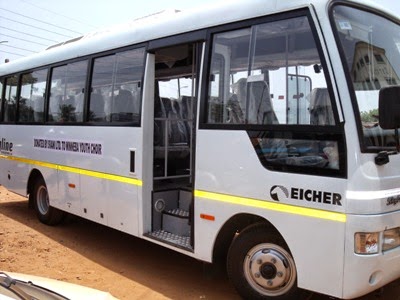
Svani Group Donates Bus To Winneba Youth Choir

By Edmund Mingle
Mr. Thomas Svanikier (second right) presenting  the keys to the
bus to Mr. Derkyi while other staff of Svani Group and members
 of the Choir look on.
Svani Group Limited, a leading automobile and logistics services firm, has donated a 35-seater bus the Winneba Youth Choir in support of the singing group’s operations.
The donation, which formed part of activities marking the silver jubilee anniversary of the company, is aimed addressing the transportation challenge facing the nation’s leading youth choir.
In addition, the presentation of the bus, worth 64,000 dollars, is to demonstrate the company’s commitment to its social responsibility.
Thomas Svanikier, Executive Chairman of Svani Group, which also has subsidiaries in the energy, oil and gas and real estate sectors, presenting the bus at Sakumono on Monday, commended the choir for its outstanding performances across the country.
Describing the choir as “ambassadors of joy,” he said the group was selected as a beneficiary of the company’s anniversary charity programme in acknowledgement of the choir’s effort in providing soothing and quality music for the soul.
 “You always sing to comfort people who are in sorrow, and celebrate with people in happy moment,” he said, adding that the donation was to assist the group to do more for the benefit of Ghanaians.
Mr. Svanikier indicated that other beneficiaries of the company’s anniversary charity programme include the Osu Salem and the Osu Girls’ schools where mechanized boreholes and toilet facilities have been provided for the students.
“We are determined in giving to address the true needs of the needy individuals and groups in society,” he said.
Mr. Adusei Derkyi, Chairman of the Winneba Youth Choir, receiving the keys to the bus, thanked the company for the gesture, which he described as “very thoughtful and timely.”
He said the gift provide a high relief for the choir which had been grappling with the challenge of means of transport in conveying the members to and from events.
According to him the high transportation cost was adversely affecting the group, resulting to its inability to honour some invitations.
“Thankfully, this gift will help us to overcome that problem,” he said.
He prayed for God’s guidance and blessings for the company, and promised that the bus would be properly maintained.
Paa John Yamoah, the Choir Master, for his part, said the choir was also marking its silver jubilee this year, adding that the donation was considered as its “best anniversary gift.”


Caption


Friday, January 30, 2015

Works Starts on 350 MW Cenpower Kpone IPP project

Vice President Amissah-Arthur breaking the ground with an escavator

From Edmund Mingle, Kpone

Vice President Kwesi Amissah-Arthur yesterday cut the sod for the construction of a 900 million-dollar Independent Power Plant at Kpone, with the aim to boosting the country’s power generation.
The plant, being built by Cenpower Generation Company, has the capacity to generate 350megawatts of power that would increase the country’s generation capacity by about 14 per cent.
The first Build, Own, Operate and Transfer (BOOT) power project, the plant is expected to be completed in 32 months. It would operate a tri-compatible system that has the ability to use gas, light crude oil and distillate to generate electric power.
The project is being funded by a consortium of international financial institutions, and the ownership of the plant would be transferred to the Electricity Company of Ghana after the expiration of the 20-year Power Purchase Agreement (PPA).
Vice President Amissah-Arthur said execution of the project, was part of government’s efforts to increase power generation to meet the high demand for electricity in the country.
“This couldn’t have come at a better time,” he said adding that the challenges in the power sector called for the active involvement of the private sector to produce more electricity to meet both industrial and domestic demand.
“We need the lights on,” the vice President said, and called for more independent power producers (IPPs) in the sector.
He noted that there were currently 16 power projects at various stages of implementation, and hoped that their completion would significantly increase the country’s power generation capacity, currently at 2,800 MW.
Vice President Amissah-Arthur assured the project managers of the government’s cooperation and support towards the successful completion of the project, and also urged them to cooperate with the host community for peaceful co-existence.
Nana Sam Brew-Butler, Chairman of Cenpower Generation Company Limited, said that among other benefits, the project incorporated a collector sub-station that would serve other projects in the energy enclave at Kpone, adding that the sub-station would eventually be transferred to the Ghana Grid Company (GRIDCo).
He said the construction stage would create employment for about 600 Ghanaians, after which about 70 jobs would be created during the operational stage.
He said as one of the largest African-led IPP projects in Africa, the project had been adjudged the best African Power Deal 2014 by the Financial Planning Institute in London.